How to Make Pour Over Coffee — Brew V60 Step by Step
A clean, bright, and endlessly repeatable cup. Master the V60 pour over with the exact ratio, grind, and pour schedule the pros use.
Updated September 21, 2026
- Brew time
- 3–4 min
- Ratio
- 1:16 (60 g/L)
- Grind
- Medium-fine
- Difficulty
- Beginner
Pour over is the best way to learn how variables like grind, water temperature, and pour speed shape flavor. With a single dripper, a filter, and a scale you can brew a café-quality cup that highlights the bright, delicate notes of a good single-origin coffee.
Free toolPour Over Brew Timer — guided V60 bloom and pour scheduleWhat you need
- A pour over dripper (Hario V60, Kalita Wave, or Origami)
- Paper filters that fit your dripper
- 20 g of fresh coffee beans (about 3 tablespoons)
- A burr grinder set to medium-fine
- A gooseneck kettle and a digital scale with a timer
- 320 g of filtered water at 96°C / 205°F
Step-by-step pour over recipe
- 1Boil water and let it settle to about 96°C (205°F).
- 2Fold the filter seam and place it in the dripper. Rinse it with hot water to remove papery taste and preheat the vessel, then discard the rinse water.
- 3Grind 20 g of coffee to medium-fine (like table salt) and add it to the filter. Shake flat and make a small well in the center.
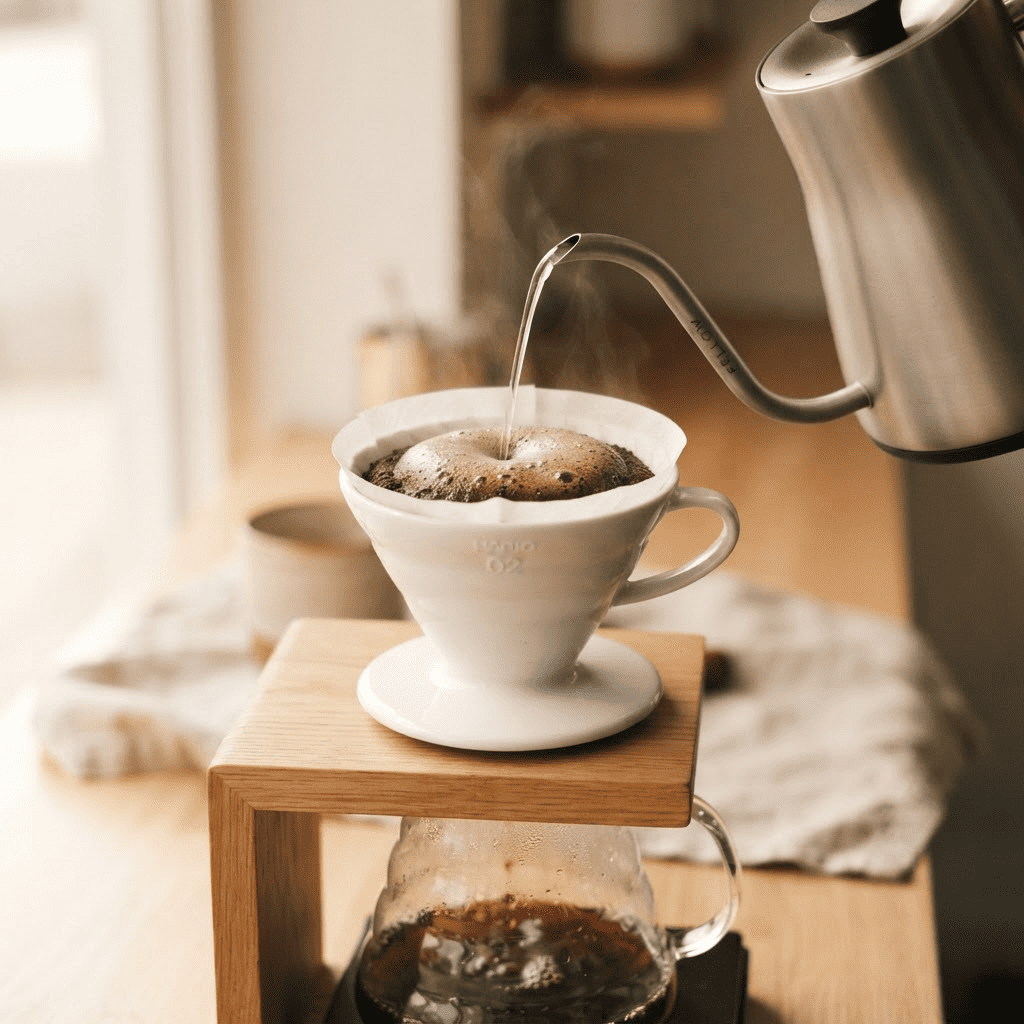
- 4Start your timer. Pour 40–60 g of water to wet all the grounds and let it "bloom" for 30–45 seconds. You will see the coffee puff up as CO₂ escapes.
- 5Pour in slow, steady spirals up to 160 g by 1:15, keeping the water level below the rim.
- 6Pour again up to 320 g total by about 1:45, staying in the center to avoid channeling.
- 7Let it draw down completely. Total brew time should land around 3:00–3:30.
- 8Swirl the carafe, pour, and enjoy.
Pro tip: If your brew finishes too fast (under 2:30) and tastes sour, grind finer. If it takes too long (over 4:00) and tastes bitter, grind coarser. Adjust one variable at a time.
Dialing in your cup
The three levers that matter most are grind size, ratio, and water temperature. Start with a 1:16 ratio (like 20 g coffee to 320 g water), then adjust grind to control brew time. Lighter roasts like hotter water and finer grinds; darker roasts prefer slightly cooler water and coarser grinds.
How pour over should taste when it is dialed in
A well-brewed pour over tastes layered and transparent. You should be able to notice sweetness first, then the acidity and aroma that make the coffee distinct. African coffees often show citrus, berries, or florals, while washed Central American coffees tend to lean toward caramel, stone fruit, and cocoa. If every cup tastes generically sharp or drying, the extraction is usually too aggressive or the water quality is muting the coffee.
Best beans and water for V60 brewing
Pour over rewards coffees with clarity, so freshly roasted single-origin beans are often the best fit. Aim to brew coffee between 7 and 30 days off roast, and use filtered water rather than distilled or very hard tap water. Water that is too soft makes the cup taste hollow; water with heavy mineral content flattens acidity and can turn bright coffees chalky. If your kettle leaves a lot of scale behind, your brew water is probably holding the cup back.
Common pour over mistakes
- Pouring too aggressively and collapsing the coffee bed, which causes channeling and uneven extraction.
- Ignoring brew weight and using volume instead of a scale, which makes consistency nearly impossible.
- Letting the slurry get too low between pours, which cools the brewer and creates astringency.
- Using stale coffee that no amount of technique can rescue.
Frequently asked questions
What is the best coffee-to-water ratio for pour over?
A 1:16 ratio (1 gram of coffee for every 16 grams of water) is the sweet spot for most pour overs. For a 20 g dose, use 320 g of water. Go to 1:15 for a stronger cup or 1:17 for a lighter, more tea-like brew.
What grind size should I use for pour over?
Use a medium-fine grind, roughly the texture of table salt. If the brew drains too quickly, grind finer; if it stalls, grind coarser.
Why do you bloom the coffee?
Blooming lets trapped CO₂ escape so water can evenly saturate the grounds. Skipping the bloom leads to uneven extraction and a thinner, less sweet cup.
What water temperature for pour over coffee?
Aim for 93–96°C (200–205°F). Light roasts like the hotter end; dark roasts often taste cleaner a few degrees cooler. If you only have a boiling kettle, wait about 30 seconds off the boil.
How long should a V60 pour over take?
About 2:30–3:30 total including the bloom. Faster and sour usually means grind finer; slower and bitter means grind coarser. Keep pours gentle so you do not dig channels in the bed.
Why does my pour over taste sour?
Sourness usually means under-extraction: grind too coarse, water too cool, or brew time too short. Grind a little finer and make sure you bloom for a full 30–45 seconds.