French Press Coffee Ratio (1:15) — Cafetière Chart & Method
The classic French press coffee ratio is 1:15. Get grams per cup, coarse grind, and a clean 4-minute steep — plus cafetière tips.
Updated September 21, 2026
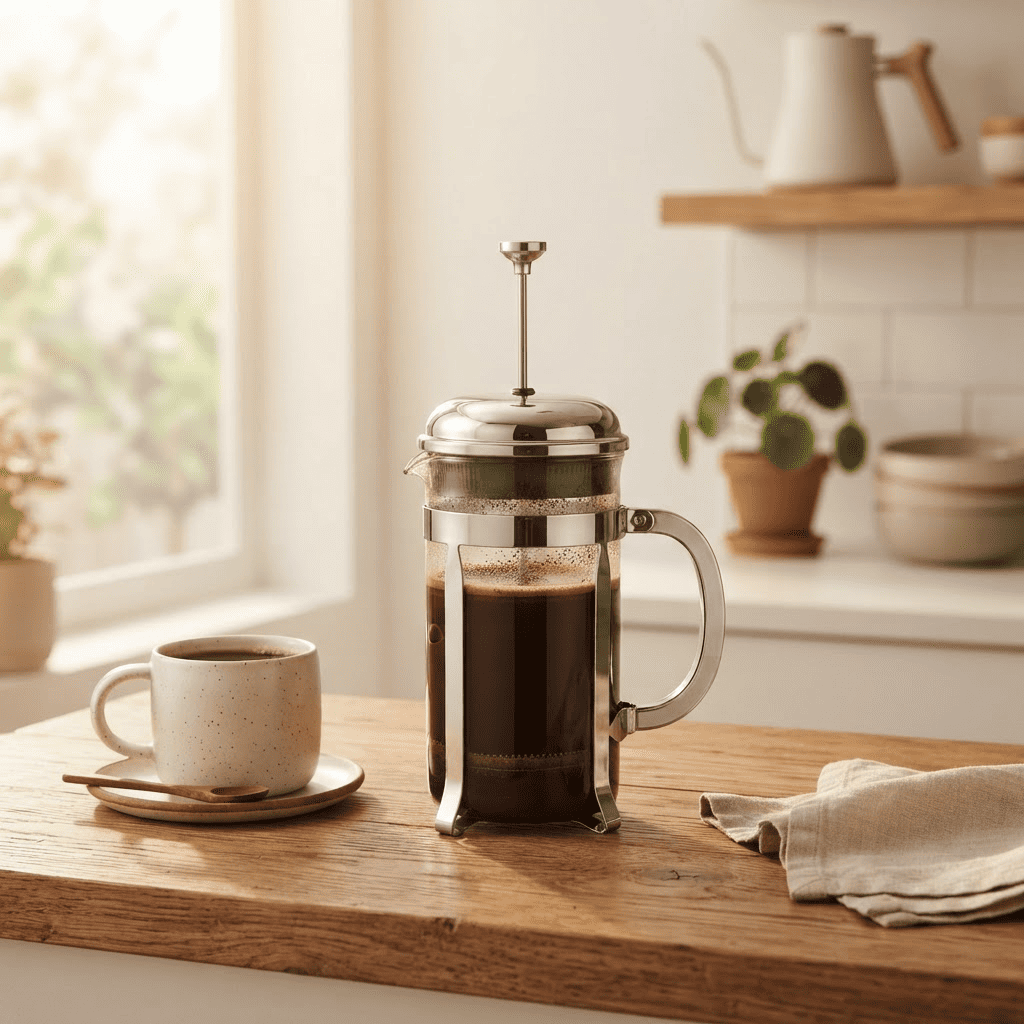
- Brew time
- 4–5 min
- Ratio
- 1:15 (67 g/L)
- Grind
- Coarse
- Difficulty
- Beginner
The French press (or cafetière) is immersion brewing at its simplest. Because the metal mesh filter lets natural oils through, it produces a heavier, richer body than paper-filtered methods. There is no pour technique to master and no specialized equipment beyond a press and a scale — making it one of the most forgiving ways to brew genuinely great coffee at home.
Free toolFrench Press Coffee Ratio Calculator — get exact grams for your press sizeWhat you need
- A French press (this recipe scales for a 1-liter / 34 oz press)
- 55 g of freshly ground coffee beans
- A burr grinder set to coarse (like raw cane sugar)
- 830 g of filtered water at 96°C / 205°F
- A digital scale and a timer
Step-by-step French press method
- 1Coarsely grind 55 g of coffee (aim for a texture like coarse sea salt — no fine dust) and add it to a dry, pre-warmed press.
- 2Start your timer and pour in all 830 g of hot water in one slow, steady pour, saturating every ground.
- 3At 1:00, break the crust that forms on the surface with a spoon, stir once, then scoop off any foam or floating grounds.
- 4Place the lid on with the plunger pulled fully up. Do not press yet — this traps heat and keeps grounds submerged.
- 5At 4:00, press the plunger down slowly and steadily to just below the waterline. It should take about 20 seconds of light pressure.
- 6Immediately pour or decant every drop into a carafe or mugs. Leaving coffee on the grounds keeps extracting and turns bitter fast.
Pro tip: Pre-warm your French press with a splash of hot water before adding grounds. It stabilizes brew temperature and helps the coffee hit the intended extraction.
French press coffee ratio per cup chart
How to make French press coffee starts with dose. Use this 1:15 chart (classic strength), coarse grind, and a 4-minute steep. For mild use 1:16; for strong use 1:14 — or open the calculator for exact grams.
Classic French press / cafetière ratio ≈ 1:15 by weight
| Serving | Water | Coffee | Tablespoons | Steep |
|---|---|---|---|---|
| 1 cup / mug | 250 ml | 17 g | ~3 tbsp | 4 min |
| 2 cups | 500 ml | 33 g | ~6 tbsp | 4 min |
| 16 oz press | 473 ml | 32 g | ~6 tbsp | 4 min |
| 8-cup / 1 litre | 1000 ml | 67 g | ~13 tbsp | 4 min |
| 12-cup | 1500 ml | 100 g | ~19 tbsp | 4 min |
Why grind size matters more than anything else
A coarse, even grind is the single most important variable in French press. Too fine and the mesh filter cannot catch the particles — you end up with a muddy, gritty cup that is also bitter because the small grounds over-extract. A truly coarse grind (coarser than most people expect) produces a clean, sweet cup with no silt at the bottom.
How to troubleshoot your cup
- Bitter and harsh: grind coarser, shorten steep by 30 seconds, or reduce the dose slightly.
- Weak and sour: grind finer (but not too fine), increase dose to 1:14, or make sure all grounds were saturated at the start.
- Gritty or muddy: your grind is too fine, or the plunger mesh needs cleaning.
- Flat and dull: check your coffee freshness — stale beans produce flat cups regardless of method.
"The French press is the most honest brewer. It shows you exactly what the coffee is. There is nowhere to hide a bad grind or a stale bean."
What coffees shine in a French press
French press emphasizes body, texture, and roast character, so coffees with chocolate, nut, spice, and ripe fruit notes perform especially well. Natural-process coffees can taste plush and jammy, while medium roasts often land in the sweet spot between richness and clarity. Very dark roasts can work, but they need slightly cooler water and shorter steeping to avoid an ashy finish.
How to make French press cleaner without losing body
If you like the richness of French press but dislike sediment, wait 5 to 8 minutes after breaking the crust before plunging. During that rest, many fine particles settle to the bottom. Press only the top half of the brew or pour gently through a small mesh strainer into your mug. You still get the oils and weight of immersion coffee, but with less grit in the final cup.
Pro tip: Want the math done for you? Open the French Press Coffee Ratio Calculator under Tools — pick a 3-, 4-, 8-, or 12-cup press and get exact grams for mild, classic, or strong. Then come back here for the full technique.
French press workflow for busy mornings
- Measure and pre-grind beans the night before only if you must; whole-bean freshness is still better.
- Heat water while the press pre-warms so you are not waiting for the glass to catch up.
- Decant into an insulated carafe immediately after pressing if you want to sip over 20 to 30 minutes.
Frequently asked questions
What is the French press coffee ratio?
The classic French press coffee ratio is 1:15 by weight — one gram of coffee to 15 grams of water (about 67 g per litre). Use 1:14 for stronger or 1:16 for milder. That is also the standard cafetière coffee ratio.
What is the cafetière coffee ratio?
Cafetière is another name for French press. Use the same 1:15 coffee-to-water ratio, coarse grind, and about a 4-minute steep. For one mug (250 ml) that is roughly 17 g of coffee.
How much coffee for French press?
For one 250 ml mug at 1:15, use about 17 g (~3 tablespoons). For an 8-cup / 1 litre press, use about 67 g. Our French press calculator sizes any press instantly.
What is the best French press coffee-to-water ratio?
A 1:15 ratio is the ideal starting point — about 55 g of coffee per 830 g of water in a 1-liter press. Use 1:14 for a bolder, stronger cup or 1:16 for something lighter. The SCA recommends 55–60 g per liter for most immersion methods.
What is the French press coffee technique?
Use a coarse grind, bloom briefly with hot water just off the boil, fill to your target weight, steep about 4 minutes, break the crust, skim foam, then press slowly and decant immediately. The technique is immersion — no pour-over spiral required — so grind size and steep time matter most.
How long should French press steep?
Four minutes is the classic steep time and works well for most coffees and grind sizes. Steeping longer extracts more — which can mean more depth or more bitterness depending on grind. Decant immediately after pressing; never let it sit.
Can I use pre-ground coffee in a French press?
Yes, but look for coffee labeled "coarse grind" or "French press grind." Standard pre-ground coffee is usually a medium grind designed for drip machines — it will over-extract and leave silt in your cup.
Why is my French press coffee bitter?
Bitterness in French press almost always comes from one of three things: grind too fine (most common), steep time too long, or water too hot. Start by going coarser on the grind.